
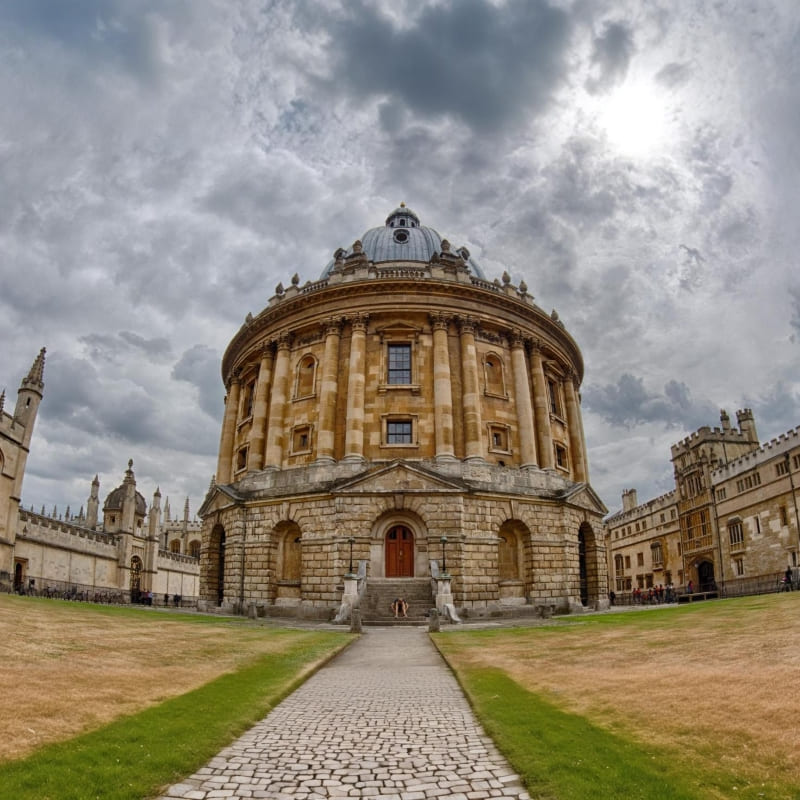
The oldest university in the English-speaking world
The university of Oxford began its rapid development in 1167 when Henry II banned English students from attending the University of Paris. By 1188, historian Gerald of Wales addressed Oxford scholars, and in 1190, the first overseas student, Emo of Friesland, arrived.
The university was formally organized by 1201, and the title of Chancellor was introduced in 1214.
In the 13th century, student-townspeople tensions led to the creation of halls of residence, later becoming colleges, including University, Balliol, and Merton. By the 14th century, Oxford was highly regarded, with Edward III praising its contributions to learning.
It became a hub of religious and political controversy, with figures like John Wyclif and John Locke challenging the status quo. The university supported Henry VIII’s divorce and the Royalist cause during the Civil War.
The 18th century saw advances in science, such as Edmond Halley’s comet prediction, and the rise of religious movements like Methodism. In the 19th century, the Oxford Movement sought to revive Catholic elements in the Anglican Church.
By 1920, women were granted full membership, and by 1986, all colleges admitted women. In the 20th and 21st centuries, the university became a leader in scientific research .
When was the university bulit
The construction of the University of Oxford is a long and complex process that evolved over centuries. It doesn’t have a single founding date, as it grew gradually over time. While teaching at Oxford can be traced back to the 12th century, the university itself did not formally exist as an institution until the 13th century.
Oxford developed as a center of learning after scholars fled from England to avoid conflict with the Church. The first colleges were established in the late 13th and early 14th centuries, starting with University College (1249), Balliol College (1263), and Merton College (1264).
Its architecture, including many of its historic buildings and colleges, was constructed over centuries, with iconic structures like the Bodleian Library and the Radcliffe Camera being added during the Renaissance and later periods.
Today, the University of Oxford is made up of numerous colleges and academic departments, with each college having its own history and buildings, contributing to the university’s rich and varied architectural legacy.
Reference from the web
#VisitEngland #Languagecourse #Englishperte