
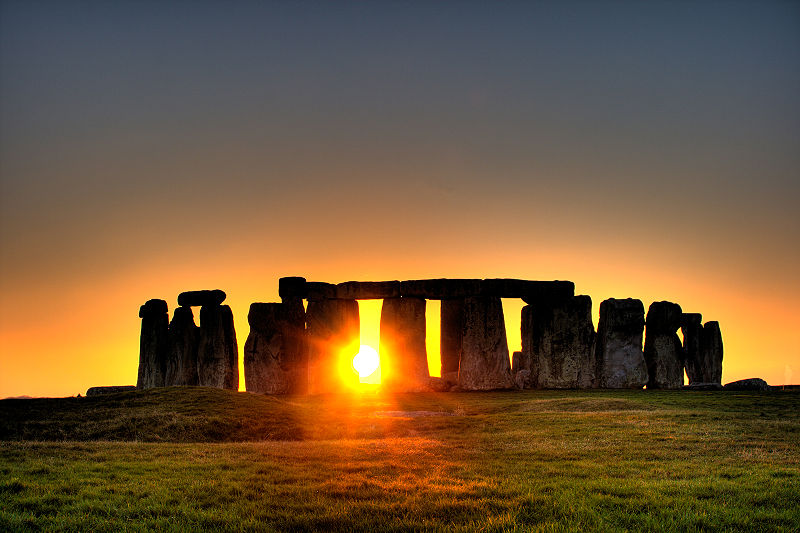
A Word Heritage Site
Stonehenge is considered a World Heritage Site and is a truly interesting place to discover. In 1986, together with Avebury, it was one of the very first sites in the UK to be designated as a UNESCO World Heritage Site.
Where and when was built this World Heritage Site
It is located on the Salisbury Plain in Wiltshire, England. Built around 5,000 years ago, the unique stone circle was erected in several stages during the late Neolithic period, approximately 2500 BC.
Stonehenge’s builders raised the stones using joints typically found only in woodworking, which were not seen at any other prehistoric monument. This, in turn, makes it the most architecturally sophisticated surviving stone circle in the world.
The monument’s purpose has been the subject of widespread speculation for centuries. Many believe, for example, that Stonehenge was a Druid temple, constructed by those ancient Celtic pagans as a center for their religious worship.
Furthermore, another theory refers to Stonehenge’s celestial influence and its apparent alignment with the sun, moon, and stars—suggesting it may have functioned as an ancient scientific observatory that connected the Earth to the sky. It was likely built to track the movement of the sun, moon, and stars thousands of years ago.
Importantly, this World Heritage Site does not stand in isolation. Instead, it forms part of a remarkable ancient landscape that includes early Neolithic, late Neolithic, and early Bronze Age monuments. This area contains more than 350 burial mounds and major prehistoric monuments such as the Stonehenge Avenue, the Cursus, Woodhenge, and Durrington Walls. As such, this landscape is a vast source of information about the ceremonial and funerary practices of Neolithic and Bronze Age people.
Virtual tour of Stonehenge:
The Skyscape website, created by English Heritage, enables people around the world to experience the skies above the iconic stone circle. It allows users to learn about the movements of the sun, moon, and planets and provides a live view of the solar alignment at Stonehenge.
To learn more about Stonehenge’s history, visit this website
#VisitEngland #Languagecourse #Englishperte